
SOC 2 vs ISO 27001: Which Framework Should You Choose?
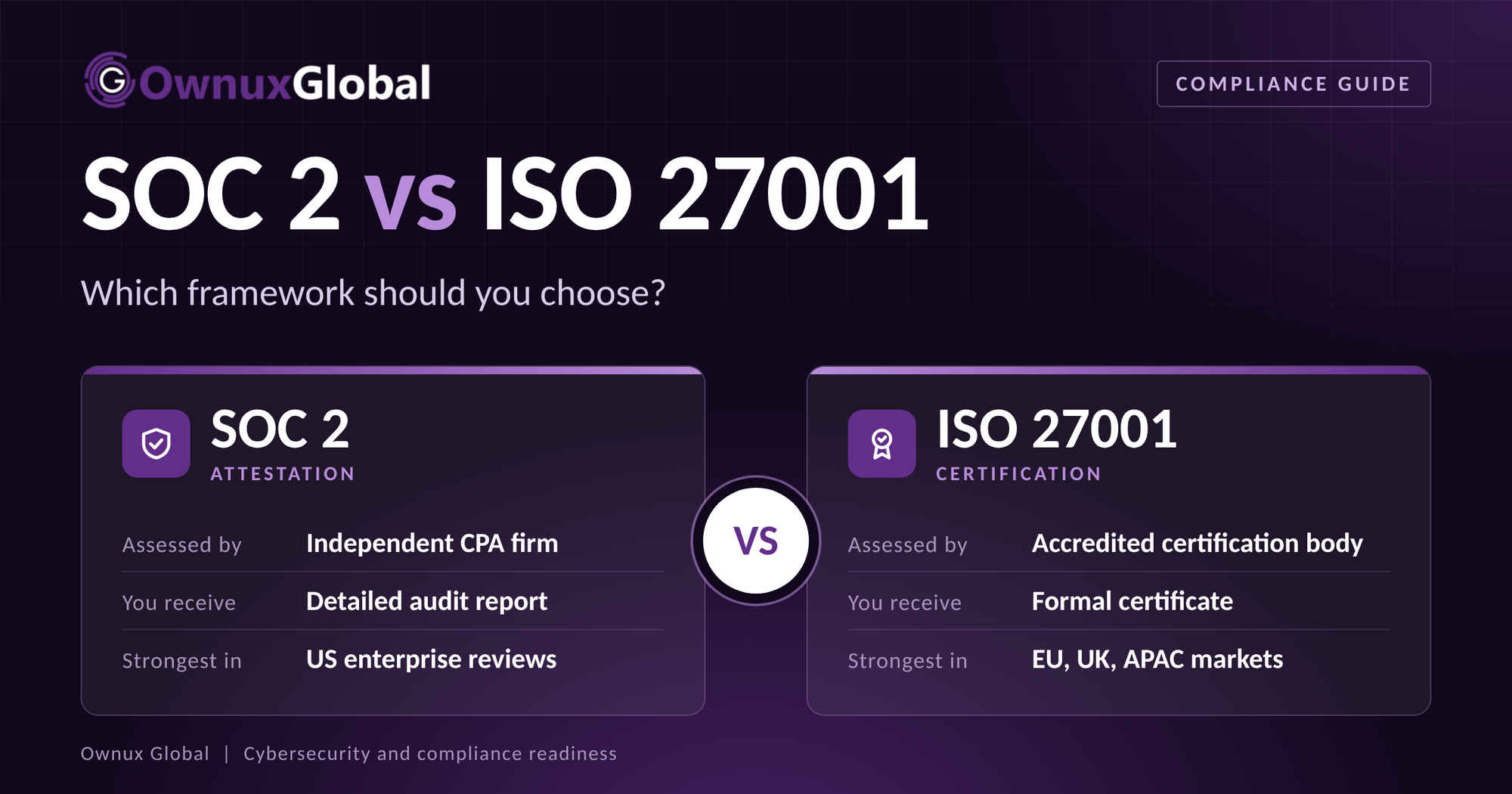
The question usually arrives attached to a security questionnaire. A prospect's procurement team asks for "SOC 2 or ISO 27001," a founder skims three vendor blogs, and the decision goes to whichever option sounded cheaper or faster.
That is the wrong way to choose. SOC 2 and ISO 27001 are not two brands of the same product. One is an independent examination of controls, reported by a CPA firm. The other is a certified management system, issued by an accredited certification body. They answer different questions, and the right choice depends on who is asking.
Our position, stated plainly:
- SOC 2 Type 2 is usually the first report for a US-focused B2B company selling to enterprise buyers.
- ISO 27001 is often the one that opens the door in the EU, the UK, much of Asia-Pacific, and sometimes with government-adjacent buyers.
- A company that needs both should build one security program, not two.
The sections below give the technical reasoning, so the decision rests on evidence instead of habit.
What Each Framework Actually Is
SOC 2: an attestation about your controls
SOC 2 is an examination performed by an independent, licensed CPA firm under AICPA attestation standards. The firm tests controls against the Trust Services Criteria, published by the AICPA as TSP Section 100, 2017 Trust Services Criteria, with revised points of focus issued in 2022. The 2022 revision changed the guidance, not the criteria.
Security, also called the common criteria, is the only mandatory category. Availability, Processing Integrity, Confidentiality, and Privacy are added by management when they matter to the service.
SOC 2 does not hand a company a fixed control list. Management describes the system, states its commitments, and designs controls to meet the criteria. The auditor tests those controls and issues an opinion. A Type 1 report covers design at a single date. A Type 2 report covers both design and operating effectiveness over a period, commonly three to twelve months. Both are restricted-use reports, shared with customers and their auditors rather than posted publicly.
Our view: that flexibility is SOC 2's greatest strength and its most common trap. The criteria reward companies that write specific controls they can operate every week. They punish companies that paste in a template and hope.
ISO 27001: a certified management system
ISO/IEC 27001 sets requirements for an information security management system (ISMS). An accredited certification body audits the system, not a product. Clauses 4 through 10 are mandatory: context, leadership, planning, support, operation, performance evaluation, and improvement.
The controls come from Annex A. The 2022 edition holds 93 controls in four themes: organizational (37), people (8), physical (14), and technological (34). A company does not have to implement all 93, but every exclusion must be justified in the Statement of Applicability, which is built from the risk assessment and risk treatment process.
The result is a certificate valid for three years, kept in good standing by surveillance audits and renewed by a recertification audit.
Our view: ISO 27001 is the stronger management discipline. It forces risk-based decisions, executive accountability, and internal audit. The cost is process overhead that small teams routinely underestimate.
The Technical Differences at a Glance
Dimension | SOC 2 | ISO 27001 |
|---|---|---|
Nature | Attestation examination | Certification of a management system |
Who assesses | Independent CPA firm | Accredited certification body |
Governing criteria | AICPA Trust Services Criteria; Security mandatory, four optional categories | ISO/IEC 27001:2022 clauses 4 to 10 plus Annex A (93 controls) |
Control selection | Management designs controls to meet the criteria; the auditor tests them | Risk-driven; recorded in the Statement of Applicability, exclusions justified |
Output | Report with auditor's opinion, system description, tests and results | Certificate stating the scope of the certified system |
Time model | Type 1 at a point in time; Type 2 over a period, commonly 3 to 12 months | Certification audit, then a recurring cycle |
Validity | Covers a defined period; buyers expect continuous annual coverage | Three years, with surveillance audits around years 1 and 2 and recertification in year 3 |
Visibility | Restricted use; a separate SOC 3 summary can be public | Certificate can be shown publicly and verified |
Typical home market | US enterprise security reviews | EU, UK, much of Asia-Pacific, sometimes government-adjacent buyers |
How failure shows up | Test exceptions listed in the report, or a modified opinion | Uncorrected major nonconformities can lead to suspension or withdrawal |
The first row explains the rest. SOC 2 answers, "Did the controls work, and what did the auditor see?" ISO 27001 answers, "Does this organization run a managed, risk-driven security system?"
How US Buyers Really Treat Each One
In US B2B sales, SOC 2 is the shared language of vendor risk teams. Security questionnaires, master service agreements, security addenda, and third-party risk platforms are largely built around it. Published comparisons from CPA and advisory firms describe the same split: SOC 2 as the default for US enterprise security reviews, ISO 27001 as the default in the EU, the UK, much of Asia-Pacific, and at times with government-adjacent buyers, and some buyers who will not accept the other as a substitute.
Three practical rules follow from that.
1. Read the contract language, not the blog post. MSAs, RFPs, and security addenda name the evidence a buyer accepts. A line such as "SOC 2 Type 2 or equivalent" leaves room to negotiate, but only if the equivalence is agreed in writing before work begins.
2. A report and a certificate carry different amounts of information. A SOC 2 report lets a security reviewer read control descriptions, test procedures, and exceptions. An ISO 27001 certificate tells the reviewer that an accredited body certified a defined scope. A reviewer who wants to see how a specific control was tested will ask for the SOC 2 report.
3. Neither document ends the questionnaire. Expect follow-up questions on subservice providers, penetration testing, incident response, and data handling. The framework earns a faster review, not a skipped one.
If the SOC 2 timeline is the open question, our guide to the honest SOC 2 timeline covers it stage by stage.
Where Each Framework Is Harder Than It Looks
SOC 2
- Control wording becomes a promise. Controls are management's own. A control stating "access reviews every quarter" must exist as dated, approved evidence every quarter of the Type 2 period. One missed review is a test exception.
- Subservice organizations need precise treatment. Under the carve-out method, which is the more common one, the system description names each subservice provider and lists the complementary subservice organization controls (CSOCs) the company relies on. The auditor does not test them. Vague CSOCs are a frequent weakness. The inclusive method tests the provider too, but it needs the provider's cooperation and is rarely used.
- Customers have duties too. The system description must state complementary user entity controls (CUECs), the controls customers are expected to run themselves.
- Auditor rigor varies. Choose a CPA firm for testing quality and standing with your buyers, not for the lowest quote. A report a security reviewer discounts is worth less than a slightly slower one they trust.
ISO 27001
- Leadership is auditable. Clause 5 requires demonstrable leadership commitment, and Clause 9 requires internal audit and management review. Certification bodies look for evidence that executives took part. That is a calendar commitment, not a document.
- The Statement of Applicability draws scrutiny. Exclusions need a risk-based reason. Exclusions made for convenience invite findings.
- Scope is visible. The certificate carries a scope statement. A narrow scope that leaves out the product the buyer actually uses is an objection waiting to happen.
- It is a cycle, not an event. A lapsed certificate means a new initial certification, and the standard itself moves. ISO 27001:2013 certificates stopped being valid after October 31, 2025, so a company must be audited against the current edition.
Our Decision Guide
Decide on buyer evidence first and internal preference second. The table below reflects our recommendations, which are judgment calls built on the technical differences above.
Your situation | Our recommendation | Why |
|---|---|---|
US B2B SaaS, enterprise buyers asking for SOC 2 | SOC 2 Type 2 first | It is the document US vendor risk teams already know how to read |
Selling into the EU, UK, or Asia-Pacific, or to multinationals with global procurement | ISO 27001 first, or alongside SOC 2 | Many buyers there ask for a certificate and may not accept an attestation in its place |
Government-adjacent or heavily regulated buyers asking for certification | ISO 27001 | Certification against an international standard is the stated requirement |
Growing in both the US and abroad | SOC 2 first for the deals in hand, then ISO 27001 on the same program | One program, two outputs, sequenced by revenue |
No customer is asking yet and basic security hygiene is thin | Neither yet; fix the fundamentals | A report built on weak controls produces exceptions, not trust |
Risk is mostly about process and governance rather than a single product | ISO 27001 | A management system fits that problem better than a controls test |
One rule sits above the table: if a named customer has asked for one of them, that answer wins. A signed deal beats a framework preference every time.
Doing Both Without Doing the Work Twice
The two frameworks overlap heavily at the control level and diverge at the management layer. That is why a single program can feed both.
Domain | SOC 2 criteria family | ISO 27001:2022 reference | Evidence that serves both |
|---|---|---|---|
Risk assessment | CC3 | Clauses 6.1.2 and 6.1.3 | Documented method, risk register, treatment decisions |
Access management | CC6 | A.5.15 to A.5.18 | Access approvals, periodic access reviews, offboarding records |
Vulnerability and logging | CC7 | A.8.8, A.8.15 | Scan results, remediation tickets, log retention and alerting |
Change management | CC8 | A.8.32 | Reviewed pull requests, approvals, deployment records |
Vendor risk | CC9 | A.5.19 to A.5.22 | Vendor inventory, due diligence, periodic reviews |
Incident response | CC7 | A.5.24 to A.5.28 | Response plan, exercise records, post-incident reviews |
Monitoring and review | CC4 | Clauses 9.2 | Internal audit results, management review minutes |
Our opinion on sequencing: pursue SOC 2 for the sale, but build the program in the shape of an ISMS from the first week. That means a documented risk method, a named owner for every control, a calendar of recurring reviews, and one evidence repository. Management-system habits are the hardest part to bolt on later, while control evidence maps across easily.
When ISO 27001 follows, the remaining work is the ISMS scope statement, the Statement of Applicability, internal audit, management review, and the two-stage certification audit. Treat any vendor that quotes a percentage of overlap without showing the mapping with caution. A mapping you can read is worth more than a number you cannot check.
Mistakes We Would Warn Any Founder About
- Choosing by brand instead of by buyer paperwork. The framework a competitor mentions is irrelevant. The one named in your prospects' contracts is not.
- Treating the ISO 27001 scope as cosmetic. A scope statement that excludes the product customers use weakens the certificate's value in a security review.
- Excluding Annex A controls for convenience. Exclusions belong in the Statement of Applicability with a risk-based reason, not a budget-based one.
- Running two programs with two owners and two evidence stores. Duplicate programs double the effort and create contradictions an auditor will find.
- Assuming one document retires the other. A buyer who asks for a SOC 2 report is rarely satisfied by a certificate alone, and the reverse is often true.
- Confusing a passed audit with a secure company. Both frameworks test what an organization chose to put in scope. Security that matters also lives outside it.
The Bottom Line
SOC 2 is a test of controls, and ISO 27001 is a system for managing security. In the US, the test usually sells first. Abroad, the system often does. Companies that grow across both markets should treat the choice as a sequence, not a contest.
Start from what customers have asked for in writing. Build the program with an ISMS's discipline. Collect evidence as the work happens. The company that does this reaches its first report, and its second framework, with fewer surprises and far less rework.
Choosing between SOC 2 and ISO 27001? Message Ownux Global to map the right sequence for your customers and your stack.
Ownux Global is a readiness and implementation partner. SOC 2 reports are issued by independent CPA firms, and ISO 27001 certificates are issued by accredited certification bodies. Ownux Global issues neither. Timelines and scope vary by company.