
SOC 2 Type 1 vs Type 2: What Each Report Proves, What It Really Costs, and Which One Wins Deals
Lets say, a mid-market buyer in the United States has chosen your product. Legal is nearly done. Then the vendor risk team sends one line: "Please share your most recent SOC 2 report."
What happens next depends almost entirely on one detail that most founders never think about until this moment: which type of report you hold, and what period it covers.
This guide is written from the delivery side of compliance. It explains what each report proves, how US buyers actually read them, where the money goes and how to choose. It also takes a firm position: a SOC 2 Type 1 is a useful tool but a poor strategy, and most companies should plan for Type 2 from the first day.
First, a correction that changes how you plan
SOC 2 is not a certification. It is an examination performed by an independent CPA firm under the AICPA attestation standards. The firm does not hand out a pass mark. It issues an opinion on management's description of your system and on your controls.
That one fact has practical consequences:
- There is no "certified" badge that means the same thing for every company. Two vendors can both hold SOC 2 reports that say very different things.
- Buyers read the document itself. A strong logo on a website does not substitute for a strong report.
- The result is a negotiation between your controls, your scope and your auditor's testing, not a checkbox.
What is actually inside a SOC 2 report
Reading the report the way a buyer does is the fastest way to understand the two types. A typical SOC 2 report contains:
- The independent auditor's report. The opinion itself, and the single most important page.
- Management's assertion. Your leadership formally states that the system description is fair and the controls meet the criteria. Leadership signs this, so it is never only an IT project.
- The system description. What the service is, its boundaries, infrastructure, software, people, data flows and the role of vendors.
- The criteria, controls and testing results. In a Type 2, this section lists every control, how the auditor tested it, and any exceptions found.
- Other information. Optional material such as management responses to exceptions.
The auditor's opinion comes in four forms: unmodified (clean), qualified, adverse and disclaimer. A clean opinion with a few documented exceptions is normal. A qualified opinion, especially one tied to security criteria, is something a US risk team will escalate.
SOC 2 reports are generally restricted-use: they are shared with customers and prospects under confidentiality, usually after an NDA. A related report, SOC 3, is a short public summary. The two should not be confused, and a SOC 3 will not satisfy a serious vendor review.
The real difference: a claim versus evidence
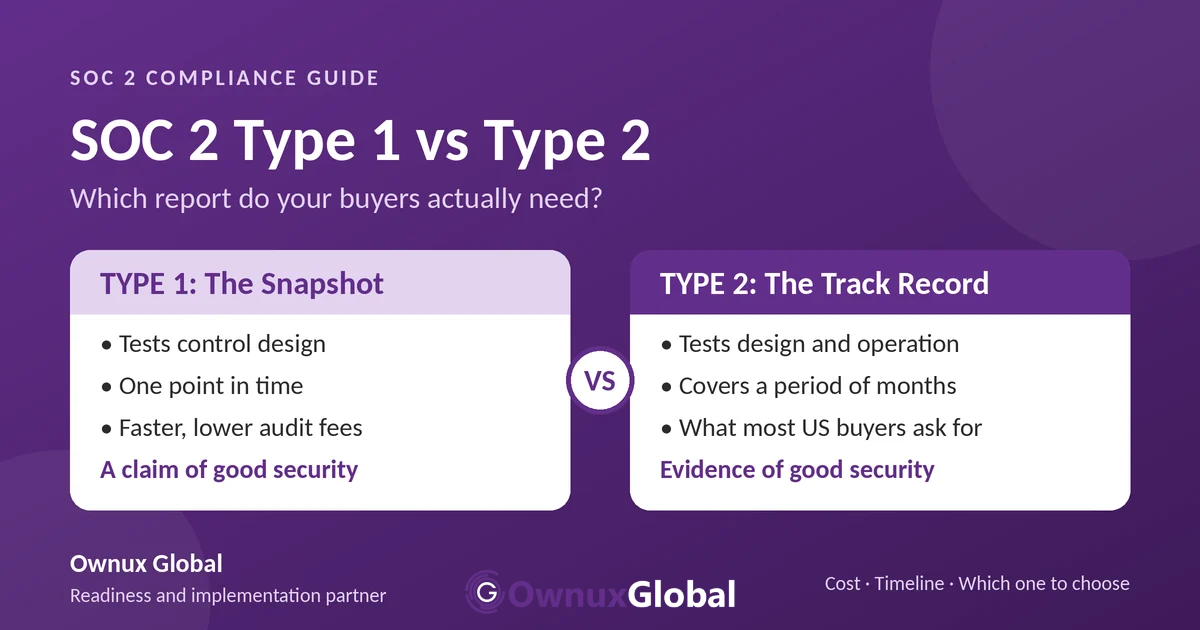
The usual definition is "Type 1 is a point in time, Type 2 is a period of time." That is accurate and incomplete. A more useful way to think about it:
| Type 1 | Type 2 | |
|---|---|---|
| Core question | Are the controls designed suitably? | Were the controls designed suitably and did they operate effectively throughout a period? |
| Auditor's method | Inspects design: policies, configurations, system settings | Tests operation using inquiry, observation, inspection and reperformance over a sample drawn from the full period |
| What is proven | A claim: "This is how we protect the system" | Evidence: "This is how it behaved, week after week" |
| Exception risk | Low. Little operating history exists to fail | Real. Missed reviews, late offboarding and skipped scans are recorded |
| Buyer reading | Intent and readiness | Operating discipline |
The key phrase is sampling over a population. In a Type 2, the auditor does not accept "we do access reviews quarterly." The auditor asks for the evidence of each review in the period, and tests whether the right person did the right thing at the right time. A control that exists on paper but lacks dated evidence will fail testing, regardless of how well the team actually performs. This is the single biggest source of surprise for first-time companies.
How a US vendor risk team really reads your report
Procurement and third-party risk teams in the United States tend to follow a quiet checklist. Knowing it lets you build a report that passes it:
- Report type. Type 2 is the default ask for anything handling meaningful customer data. Type 1 is often accepted only as a temporary measure, with a commitment to deliver Type 2 later.
- Period end date. Reviewers look at how recent it is. A report whose period ended long ago raises questions, which is why many buyers prefer coverage that ended within the last year.
- The opinion. Clean, qualified or worse.
- Scope and system boundary. Does the report cover the product the buyer is actually purchasing, or a narrow slice of it? A beautiful clean report on a limited scope can be worth less than a modest report on the right one.
- Trust Services Criteria included. Security is always present. A buyer storing sensitive data with you may expect Confidentiality. A buyer who depends on uptime may expect Availability.
- Exceptions. Reviewers read these closely. One exception on a minor control rarely matters. A pattern around access or change management does.
- Subservice organizations. If your product runs on a cloud provider, is that vendor handled by the carve-out method (excluded, with your reliance on their report described) or the inclusive method (included in your scope)? Carve-out is common, it simply means the buyer must also trust the provider's own report.
- Complementary user entity controls (CUECs). These are the controls the customer must operate for your controls to work. Buyers check that they can realistically meet them.
- Bridge (gap) letter. If the period ended months ago, management can issue a letter stating that no significant changes or incidents have occurred since. It is not a substitute for a report, but it keeps a current deal moving.
Seen this way, the question is not "Type 1 or Type 2?" It is "What will make this specific reviewer comfortable, and how fast can that be delivered?"
The case against Type 1 as a default strategy
A Type 1 is faster and cheaper. It is also the easier audit to pass, and experienced reviewers know it. Three problems follow:
1. It answers a question the buyer already assumes. Most reviewers expect that a company has written policies and sensible settings. The real doubt is whether the company lives by them.
2. It can double the work. Companies that take Type 1 first often repeat the scoping, evidence collection and auditor onboarding when they move to Type 2. The earlier report becomes a stepping stone with its own invoice.
3. It can set a false expectation internally. Leadership sees a completed report and assumes the program is finished. In reality, the hardest period, running every control with dated evidence for months, is just starting.
Type 1 is also not a prerequisite for Type 2. A company with stable controls can start the observation period directly.
When Type 1 is the smart move
Used deliberately, Type 1 is a useful bridge. It makes sense when:
- A specific deal is waiting on a report this quarter, and the buyer has confirmed in writing that Type 1 plus a Type 2 commitment is acceptable.
- The control environment is still being built. A design level examination can reveal gaps before an observation clock starts running against them.
- Leadership needs a milestone. A concrete deliverable can sustain internal momentum during a long program.
If none of these is true, a company is usually better off spending the same effort on a well scoped Type 2.
The window decision most guides skip
The most strategic choice in a Type 2 is not the auditor. It is the observation period: its start date, length and end date.
The standards do not set one universal minimum, and practice has settled into patterns. Auditors commonly want a few months of history for a first report, and many buyers prefer to see six months or more. A first report with a shorter window gets a company a credible Type 2 sooner, and it is followed by a full year report afterwards.
A practical approach:
- First report: a shorter window (often three to six months). The goal is a dated, clean Type 2 in front of buyers as early as possible.
- Second report onward: twelve months, continuous. Consecutive annual coverage with no gaps tells buyers the program is permanent.
- Choose the end date on purpose. Aligning the period end with the sales calendar, such as the quarter before a big renewal cycle, means the freshest possible report is available when it is most useful.
A gap between periods is itself a signal. Buyers notice when coverage lapses, so continuity matters as much as the first report.
What SOC 2 really costs: think in layers
Search results love a single price. A single price is not how SOC 2 spending works. A more honest model has five layers, and the audit fee is usually not the largest one:
- Readiness and gap assessment. Mapping current controls to the criteria and producing a remediation list.
- Remediation. Building what is missing: access governance, change management, logging and monitoring, vendor risk management, incident response, security awareness training, and policies that match reality.
- Tooling. Evidence collection, endpoint management, vulnerability scanning, identity and logging tools. Some are already owned some are new.
- The auditor's fee. Planning, testing, review and reporting, driven mostly by scope and complexity.
- Internal time. Engineering, IT, HR and leadership hours. This is real money even when it never appears on an invoice.
Directional benchmarks. Published industry estimates for small and mid sized companies commonly place CPA firm fees for a Type 1 in roughly the $5,000 to $25,000 range and for a Type 2 in roughly the $10,000 to $50,000-plus range, with total first year program cost running meaningfully higher once readiness, tooling and internal effort are counted. These are planning figures, not quotes. Real numbers vary with scope, company size, the number of systems and vendors, and how organized the evidence is.
What drives cost the most:
- Number of Trust Services Criteria in scope. Each added criterion adds controls and testing.
- System complexity. Multiple cloud environments, many integrations and a large production footprint all expand the sample.
- Evidence quality. Disorganized evidence produces back and forth, which produces billable time.
- Exceptions. Each one invites questions, remediation explanations and sometimes additional testing.
- Scope creep during the engagement. Changing boundaries mid audit is among the most expensive mistakes.
An opinion on cost: the cheapest SOC 2 is the one done once, done properly and renewed on schedule. Programs built in a rush, reworked after a failed first window, and re-audited are the expensive ones.
A timeline you can plan backward from
Work backward from the date a report must be in a buyer's hands. A realistic Type 2 program usually moves through these phases:
| Phase | What happens | Planning note |
|---|---|---|
| Scoping and readiness | Define system boundary and criteria, run gap assessment | Typically weeks, not days, for a company starting from zero |
| Remediation | Close gaps, deploy controls, write policies that match practice | Often the longest phase, depends on engineering capacity |
| Observation period | Controls run, evidence is generated and retained | Fixed by calendar, cannot be accelerated |
| Fieldwork and testing | Auditor samples evidence, interviews staff, tests controls | Smooth when evidence is organized |
| Report issuance | Draft review, management assertion, final report | A few weeks after fieldwork in many engagements |
The unavoidable rule: the observation period is calendar time. No tool, consultant or budget compresses it. A company that begins in January for a contract that must close in March will not have a Type 2 by then. Starting earlier than feels necessary is the cheapest accelerator in compliance.
Scope decisions that matter more than the report type
Many teams spend weeks debating Type 1 versus Type 2 and minutes on scope. The scope usually deserves the reverse.
Start with Security only, unless a contract says otherwise. Security (the Common Criteria, covering control environment, risk assessment, monitoring, logical and physical access, system operations, communication, information, control activities change management and risk mitigation) is always required. Availability, Confidentiality, Processing Integrity and Privacy add real testing. Add them when customers or data types demand them, not as decoration.
Draw the system boundary around what customers buy. Including internal tools unrelated to the service adds cost without adding buyer confidence. Excluding something customers clearly depend on creates doubt.
Decide how to treat subservice providers early. Carve-out or inclusive handling changes both the auditor's work and what the buyer must separately review.
Match the criteria to the data. A company hosting regulated or highly sensitive customer data will face a different set of buyer expectations than one storing basic business records.
Exceptions: what is survivable and what is not
Fear of exceptions leads some teams to over-engineer. A better view:
- Isolated, low-impact exceptions with a clear explanation and remediation are common and typically acceptable.
- Repeated exceptions in the same control signal a process failure, not bad luck.
- Exceptions in access control, change management or incident response draw the closest attention, because they sit at the center of how buyers judge risk.
- A qualified opinion is a serious event. It does not end a business, but it does require a clear remediation story for every buyer who asks.
The most effective prevention is boring: scheduled reviews on a calendar, owners named for each control, and evidence captured when the work is done rather than reconstructed later.
How to choose: four common situations
A startup landing its first enterprise deal. Confirm in writing what the buyer will accept. If Type 1 plus a Type 2 commitment is acceptable, consider the bridge. Start the Type 2 window immediately either way.
A growing SaaS company drowning in security questionnaires. Go straight to Type 2. The report will remove a large share of repetitive questionnaire work and shorten future sales cycles.
A company serving healthcare, financial services or other regulated buyers. Plan for Type 2 and consider whether Confidentiality and Privacy belong in scope. Buyers in these sectors tend to ask hard questions about both.
A managed service provider or IT vendor with access to customer environments. Expect scrutiny of access governance, change management and monitoring. A narrow scope that excludes the delivery environment will not satisfy these buyers.
Five mistakes experienced practitioners see repeatedly
- Writing policies to sound impressive instead of to be followed. Auditors test behavior against the policy as written. An unrealistic policy manufactures exceptions.
- Starting the observation window before controls are stable. Known gaps become permanent entries in a report.
- Treating evidence as an end-of-year chore. Evidence that is generated at the time of the activity is faster to collect and harder to dispute.
- Picking an auditor on price alone. The firm's reputation travels with the report. Industry experience and quality of communication matter.
- Letting coverage lapse. A gap between periods weakens the story the program is meant to tell.
The bottom line
A Type 1 report says a company has built its controls properly. A Type 2 report says those controls keep working when no one is watching. For buyers handling real data, the second statement is the one that closes risk reviews.
Treat Type 1 as a tool for a specific deadline, not as a destination. Scope with discipline, choose the observation window on purpose, collect evidence as the work happens and plan the calendar backward from the deal that depends on it.
Frequently asked questions
What is the main difference between SOC 2 Type 1 and Type 2? Type 1 evaluates whether controls are suitably designed at a single point in time. Type 2 evaluates both design and whether controls operated effectively across a defined period.
Is SOC 2 a certification? No. It is an attestation report in which an independent CPA firm gives an opinion on a company's controls. That is why scope and report contents matter so much.
Can a company go straight to Type 2? Yes. Type 1 is not required first.
How long does a SOC 2 Type 2 observation period last? There is no single universal figure. First reports commonly cover a few months, and mature programs typically move to twelve-month continuous coverage.
How often does SOC 2 need to be renewed? Buyers generally expect coverage to be current and continuous, so most companies repeat the examination annually.
What is a bridge letter? A letter from management that covers the time between the end of the report period and the present date, stating whether significant changes or incidents have occurred.
Does SOC 2 replace ISO 27001? No. They serve different buyer expectations. SOC 2 is the more common request from US customers, while ISO 27001 is a certification issued by an accredited certification body and is often requested internationally.
Plan the right SOC 2 path before the deadline plans it for you
Ownux Global supports companies as a readiness and implementation partner, covering scoping, gap assessment, control implementation and evidence preparation, so the independent CPA firm's examination runs smoothly. Ownux Global does not issue SOC 2 report that role belongs to the auditor you select.
Book a SOC 2 readiness conversation with Ownux Global to map your scope, timeline and the report your buyers expect.