
SOC 2 Readiness Checklist: The 8-Week Process We Use With Clients
Why most SOC 2 efforts stall before the first control is built
Most SOC 2 programs do not fail at the audit. They fail in week three, when a team realizes the policy pack it bought has little to do with how the company actually works.
Our position is simple: SOC 2 readiness is an operating discipline, not a document project. A binder of policies with no running controls behind it can survive a sales call, then fall apart in front of an auditor. US enterprise buyers have become good at spotting the difference. Security reviews now ask for the report itself, the period it covers and the exceptions it lists, not just a badge on a trust page.
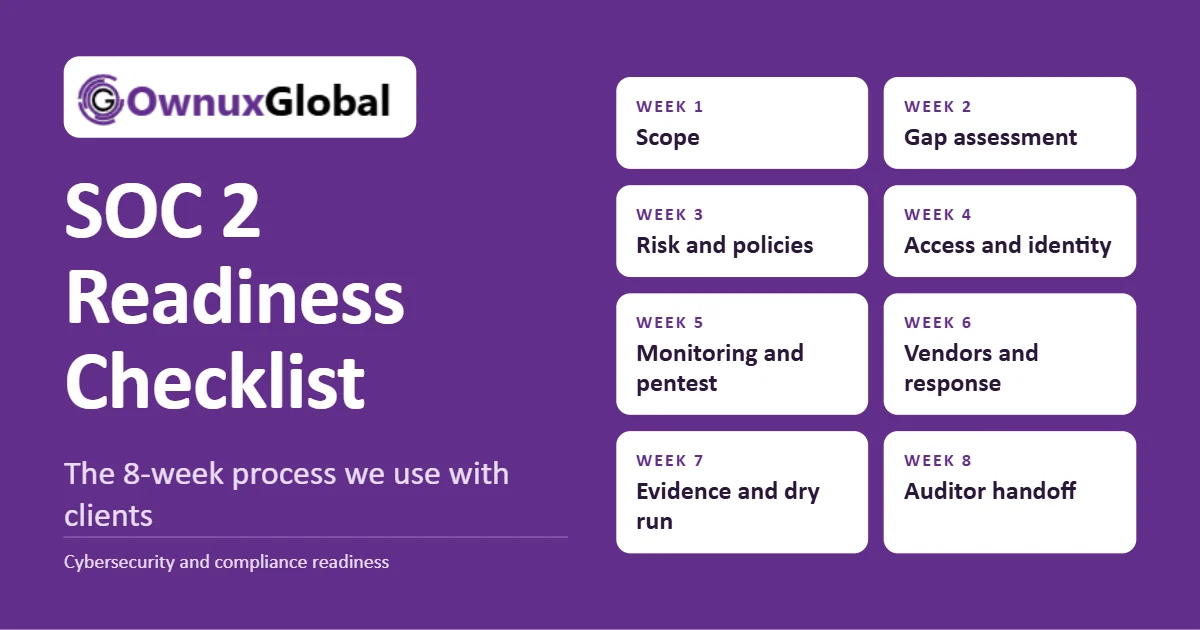
This checklist is the eight-week sequence Ownux Global uses with clients to move a service organization from "we need SOC 2" to a state where an independent CPA firm can start its work with confidence. It is opinionated on purpose. Where common advice is lazy or wrong, we say so.
One boundary before we begin. Ownux Global is a readiness and implementation partner. SOC 2 reports are issued by independent, licensed CPA firms, and no readiness program replaces that attestation.
What SOC 2 readiness really means, and what eight weeks can deliver
SOC 2 is an attestation framework created by the AICPA. It evaluates controls against the Trust Services Criteria, which are grouped into five categories: Security, Availability, Processing Integrity, Confidentiality and Privacy. Security is the only category required in every SOC 2 report. The other four are added when the service and the customer commitments justify them.
We define readiness as a state, not an activity. A company is ready when its scope is fixed, its controls are designed and already running, evidence flows without heroics, and the people who own each control can explain it in their own words.
Eight weeks is realistic for a focused team: one core product, a manageable headcount, an executive who owns the outcome and engineers who are given time. It is not realistic for a company with several unrelated products, no named IT owner or a stalled leadership team.
Be clear about what eight weeks produces. It produces a Type 1 ready state, where controls are designed and in place at a point in time, and it positions the company to open a Type 2 observation window. A Type 2 report covers both design and operating effectiveness over a period, commonly three to twelve months, with three months the usual floor for a first report. Anyone promising a Type 2 report in eight weeks is misrepresenting how the standard works.
Week 1: Fix the scope before anything else
Scope is the cheapest control a company will ever write, and the most expensive one to get wrong. Every extra system, team and vendor pulled into scope adds controls to design, evidence to collect and exceptions to explain.
What gets done
- Define the system in plain terms: the product, the infrastructure it runs on, the people who operate it, the data it handles and the vendors it depends on.
- Choose the Trust Services categories. Security is always included. Add Availability when customers hold the company to uptime commitments. Add Confidentiality when contracts promise protection of specific customer data. Add Privacy or Processing Integrity only when customers genuinely rely on them.
- Decide the target report type and date, working backward from the deals that actually need it.
- Name one accountable owner and one executive sponsor. A committee is not an owner.
Our position: Over-scoping is the most common self-inflicted wound in first-time programs. A Security-only first report is a legitimate, defensible choice for many SaaS companies. Add categories when a customer or contract asks for them, not because a framework lists them.
Exit check: A one-page scope statement that the sponsor has signed and engineering agrees is accurate.
Week 2: Run a gap assessment that tests reality
A gap assessment should answer one question: what would an auditor find today? That requires evidence, not opinions.
What gets done
- Map existing practices to the Common Criteria, CC1 through CC9: control environment, communication, risk assessment, monitoring, control activities, logical and physical access, system operations, change management and risk mitigation.
- Interview the people who do the work, not only the people who wrote the policy.
- Sample real records. Pull the last five departed employees and check whether access was removed, and how fast. Pull recent production changes and look for the review trail.
- Rank each gap by risk and effort, then turn the list into a remediation backlog with an owner and a date on every line.
Our position: A gap assessment completed as a yes-or-no questionnaire is theatre. It flatters the company and misses exactly what an auditor samples. The honest version is slightly uncomfortable, and that discomfort is the value.
Exit check: A prioritized backlog the engineering and operations leads have read and accepted.
Week 3: Build the risk assessment, then write fewer policies
Policies come after risk, not before. A policy set written without a risk assessment tends to describe an imaginary company.
What gets done
- Run a documented risk assessment covering the in-scope system: threats, likelihood, impact, existing controls and a named owner for each material risk. Keep the register alive, because auditors expect it to be reviewed, not filed.
- Write the core policy set: information security, access control, change management, incident response, vendor management, business continuity and disaster recovery, data classification and retention, acceptable use and secure development.
- Have leadership approve the policies and have every employee acknowledge them.
Our position: Short policies that match daily practice beat long policies copied from a template. If a policy says access is reviewed quarterly and the company reviews it yearly, the company has just written its own audit exception. Write what the team does, then improve it deliberately.
Exit check: An approved risk register and a policy set that engineers can read in one sitting and recognize as their own process.
Week 4: Lock down access, identity and endpoints
If only one week receives full engineering attention, make it this one. Access is where most customer data risk lives and where audits tend to find the most exceptions.
What gets done
- Put every in-scope system behind single sign-on where possible, with multi-factor authentication on cloud consoles, source control, production access and email.
- Apply least privilege through defined roles. Remove shared accounts and move secrets into a managed store.
- Formalize joiner, mover and leaver steps with a ticket trail, and schedule recurring access reviews with a reviewer who is not the person holding the access.
- Enforce disk encryption, screen locks, patching and device management on company laptops.
- Run security awareness training and keep completion records.
Our position: An access review that nobody can evidence did not happen. Build the review as a recurring task with a named reviewer, a defined data source and a saved output. That one habit prevents a large share of avoidable findings.
Exit check: A demonstrated leaver test: a mock departure is processed end to end and every account is closed within the policy window.
Week 5: Make vulnerabilities and monitoring someone's job
Detection and vulnerability management are where a program proves it is alive. This is also the week to book an independent penetration test, so findings arrive with time left to fix them.
What gets done
- Centralize logs for production systems and identity providers, and route alerts to a named person or rotation.
- Set a vulnerability scanning cadence and remediation targets by severity, then track them in the same system engineers already use.
- Confirm encryption in transit and at rest, and run a real backup restore test.
- Commission a penetration test scoped to the in-scope system. SOC 2 does not hand every company the same checklist, but auditors and enterprise buyers expect to see vulnerability work backed by independent testing.
Our position: An alert nobody reads is not a control. And a pentest report is a deliverable to be reviewed, not a trophy to be filed. Check that the scope matches the contract, the methodology is named, every severity rating shows its CVSS vector and the retest terms are defined. Ownux Global's guide, 12 Things to Check in a Pentest Report, covers this in detail. The same discipline also supports ISO 27001:2022 Annex A control 8.8 on technical vulnerabilities if a second framework is on the roadmap.
Exit check: A pentest booked or delivered, a scan history with tracked fixes, and one successful restore from backup.
Week 6: Vendors, change control and incident response
Three controls, one theme: how the company behaves when something outside the normal path happens.
What gets done
- Build a vendor inventory ranked by criticality. For critical vendors, collect their own assurance reports and read the sections on subservice organizations and user entity controls, since some responsibilities land back on the customer.
- Require peer review and passing automated checks before code reaches production. Document a separate, logged path for emergency changes.
- Write an incident response plan with roles, severity levels, escalation contacts and a customer notification process.
- Run a tabletop exercise and keep the notes.
Our position: The tabletop matters more than the plan. A plan nobody has rehearsed tends to fail on the first real call, usually on a simple question like who is allowed to tell customers. Practice that question now, while it is cheap.
Exit check: An approved vendor register, a visible code review trail and a documented tabletop with actions assigned.
Week 7: Design the evidence, then rehearse the audit
Controls that run but leave no trail are invisible to an auditor. Week 7 turns operations into evidence.
What gets done
- For every control, record what the evidence is, which system produces it, how often it is generated and who owns it.
- Decide how evidence will be collected. A compliance platform can remove screenshot work, but it does not make a company compliant on its own.
- Hold a minuted management review of risks, incidents and open remediation items.
- Run an internal mock audit. Someone who does not own the control samples the evidence and tries to break it.
- Fix what the mock audit finds, and fix the process that caused it.
Our position: Buy tooling after the process is stable, not before. Automation applied to a messy process produces messy evidence faster. The mock audit is the most underused step in the whole program, and it is the closest thing to a rehearsal the company will get.
Exit check: An evidence map covering every in-scope control and a mock audit with all findings closed or formally accepted.
Week 8: Choose the auditor and hand off cleanly
A SOC 2 report is issued by a licensed CPA firm that is independent of the company and of its readiness partner. Week 8 is about choosing that firm well and arriving prepared.
What gets done
- Shortlist CPA firms and ask practical questions: experience with companies of this size and stack, how evidence requests are sequenced, how exceptions are communicated, and whether the firm will support a Type 1 followed by a Type 2 window.
- Draft the system description and management assertion, which are the company's own statements about the system and its controls.
- Hold a final readiness review with the sponsor and control owners.
- Set the Type 1 date or the start of the Type 2 observation window, and calendar the recurring control tasks that will run during it.
Our position: Choose the auditor on communication quality and fit, not only on the lowest quote. A responsive firm that understands the product saves more time than a cheap one that asks the same question three times. And if a named deal is waiting, take Type 1 first. If not, opening the Type 2 window early is usually the better use of the calendar.
Exit check: A signed engagement with a CPA firm, an agreed start date and every control owner clear on what happens next.
Six mistakes that stall SOC 2 programs
- Buying software to decide scope. Tooling should follow a scope decision. A platform cannot tell a company what its system boundary is.
- Treating it as the security team's project. Controls live in engineering, HR, IT and operations. If those leaders are not in the room in week one, the work stalls in week four.
- Starting the observation window too early. Any control failure inside the window can appear as an exception in the report. Start it when controls are stable, not when the calendar feels urgent.
- Relying on one hero to produce evidence. If a single person assembles screenshots at the last minute, the control is not repeatable and will not survive turnover.
- Copying someone else's policies unchanged. Auditors test against what the policy says. A borrowed promise becomes the company's own liability.
- Confusing a report with a guarantee. SOC 2 shows that controls were designed, and for Type 2 operated, as described. It does not prove the company cannot be breached, and good buyers know that.
The 8-week SOC 2 readiness checklist at a glance
Week | Focus | Exit check |
|---|---|---|
1 | Scope, categories, report type | Signed one-page scope statement |
2 | Gap assessment | Prioritized backlog with owners and dates |
3 | Risk assessment and policies | Approved risk register and policy set |
4 | Access, identity, endpoints | Leaver test passed end to end |
5 | Monitoring, vulnerabilities, pentest | Pentest booked or delivered, restore tested |
6 | Vendors, change control, incident response | Vendor register, review trail, tabletop notes |
7 | Evidence and mock audit | Evidence map complete, findings closed |
8 | Auditor and handoff | CPA engagement signed, start date set |
SOC 2 readiness FAQ
How long does SOC 2 readiness take? For a focused team with one core product, eight weeks is a realistic path to a Type 1 ready state. A Type 2 report adds an observation period, commonly three to twelve months, plus auditor fieldwork and report writing.
Is SOC 2 a certification? No. It is an attestation. A licensed CPA firm examines the controls and issues a report. The phrase "SOC 2 certified" is common in sales language, but the report is the real artifact buyers should ask to see.
Is SOC 2 required by law? No. It is a market requirement driven by customer contracts and security reviews, not a statute.
Which Trust Services categories are mandatory? Only Security. Availability, Processing Integrity, Confidentiality and Privacy are optional and chosen based on the service and customer commitments.
Should a startup start with Type 1 or Type 2? Take Type 1 when a specific deal needs proof soon. Otherwise, many companies are better served by moving toward a Type 2 window once controls are stable, because that is the report most enterprise buyers ultimately ask for.
Does a company need a compliance platform? Not necessarily. Platforms reduce manual evidence work, but the controls and the discipline behind them matter more than the software.
The bottom line
SOC 2 rewards companies that run their security the same way every week, with or without an audit on the calendar. The eight weeks above are not a shortcut. They are a sequence that puts scope first, evidence second and tooling last, which is the order that holds up under scrutiny.
If SOC 2 is on the roadmap, the most useful next step is a scoped gap assessment against real evidence. Talk to Ownux Global about an 8-week SOC 2 readiness plan for your team.
Ownux Global is a readiness and implementation partner. SOC 2 attestation is performed by independent CPA firms. ISO 27001 certification is issued by accredited certification bodies.