
Digital Personal Data Protection Act (DPDPA) 2023: Impact And Challenges

Abstract
The analysis explores the significant technical challenges facing MSMEs, large corporations and government entities. The article concludes with recommendations for achieving compliance and fostering a "privacy-by-design" culture.
Read our 1st part on DPDPA rules
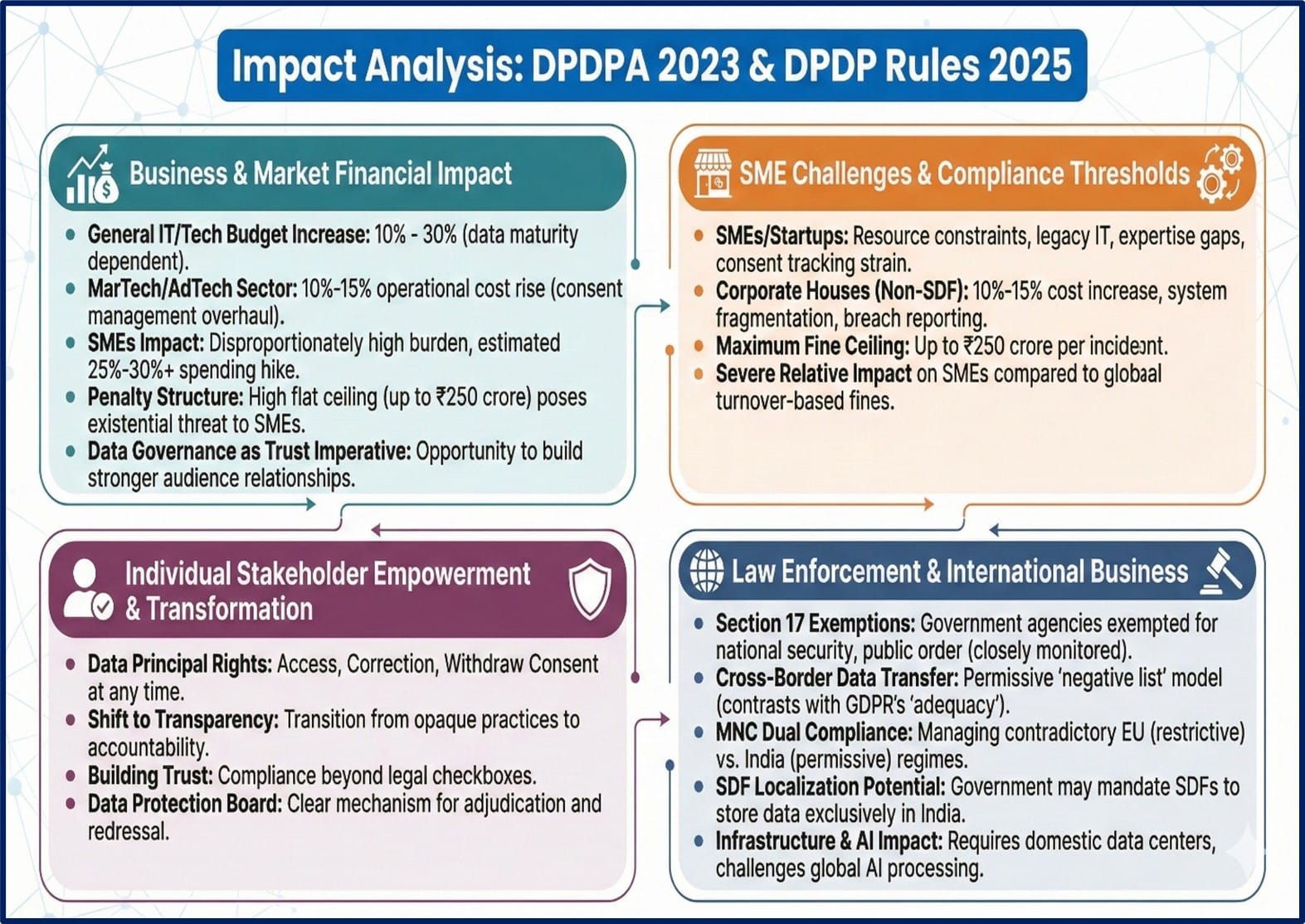
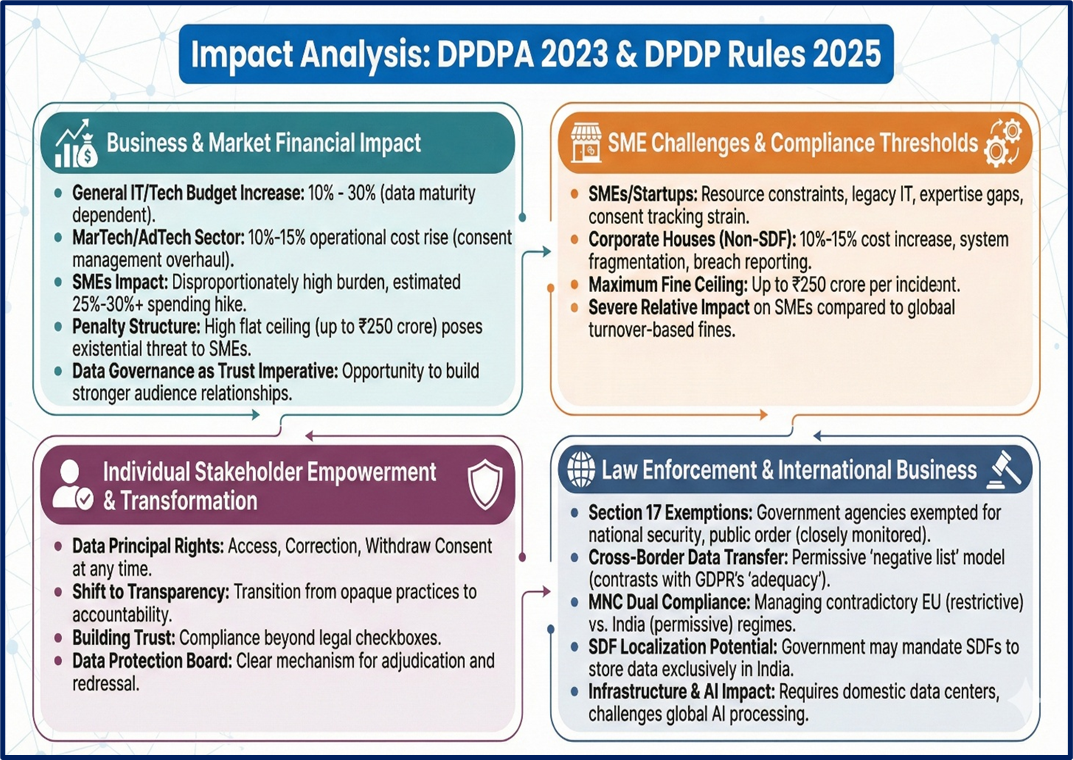
Impact: DPDPA 2023 & DPDP Rules 2025
Impact on individuals (Data Principals)
- Stronger rights to know how data is used, seek correction/erasure, and complain in case of misuse, supported by standardized consent formats and grievance processes.
- Better protection for children, reduced dark‑pattern consent and clearer accountability of large platforms and the state.
Impact: Small and Medium Businesses (MSMEs/SMEs)
- Mandatory compliance where digital personal data is processed, with more limited but still material obligations around consent, notices, security and breach notification.
- For most MSMEs, classification as SDF is unlikely, but sectoral or volume‑driven designation is possible for fintech, health-tech, edtech and major SaaS providers.
Impact: Large Corporates and Conglomerates
- DPDPA will drive comprehensive privacy governance: enterprise‑wide policies, privacy‑by‑design, role‑based access, vendor management, and demonstrable accountability.
- Many large enterprises and critical service providers are likely to be designated as Significant Data Fiduciaries, triggering requirements for DPO appointment, periodic independent audits, DPIAs, and more formal risk management.
Impact: Government Law and Enforcement
- The Act provides “legitimate use” and exemption pathways for state agencies for sovereignty, security, public order, and crime prevention, but within a statutory structure subject to future rule‑making and judicial scrutiny.
- Government entities become large Data Fiduciaries, subject to security, breach management and rights‑handling obligations, except where expressly exempted.
Impact: International Business
- DPDPA’s extraterritorial reach applies to entities outside India offering goods/services to individuals in India, requiring them to comply with Indian rules (including consent, notices, rights handling and DPBI enforcement).
- Cross‑border data transfers will be allowed by default except to a government‑notified negative list of countries or sectors, with additional conditions for critical sectors.
Challenges in Implementing the DPDPA Rules 2025 in India
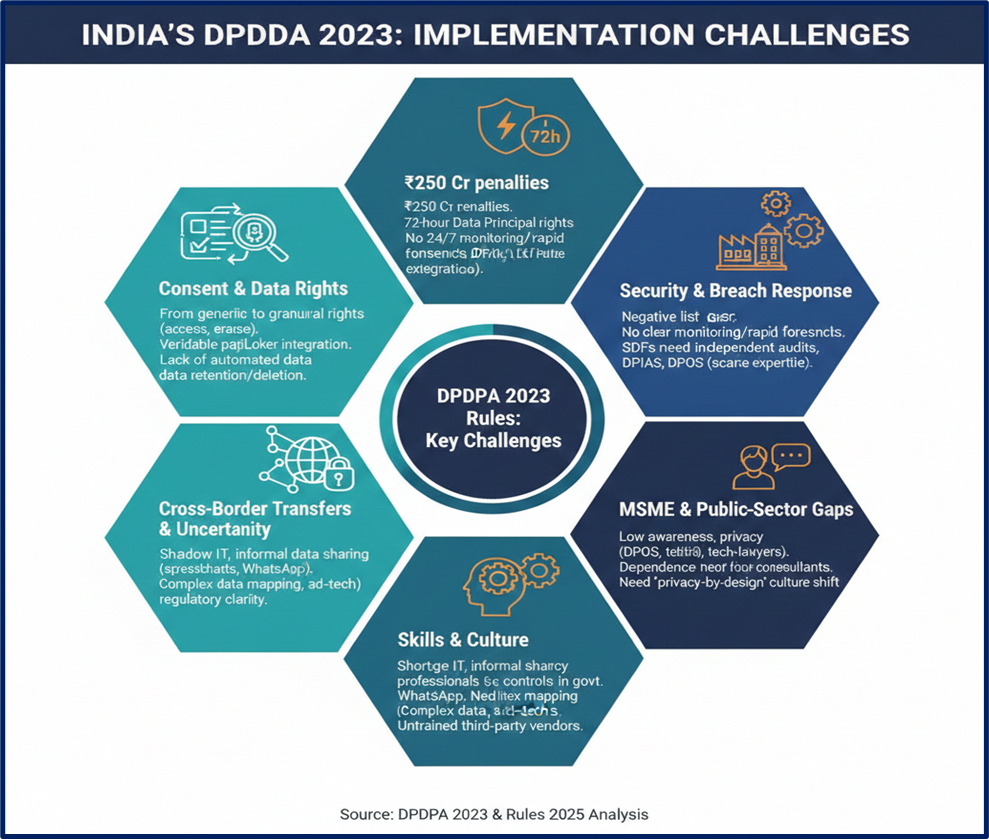
Implementing the DPDPA Rules 2025 in India will be difficult primarily because they demand rapid, organisation‑wide changes to technology, processes and culture. The main challenges revolve around consent and rights operations, security and breach response, cross‑border uncertainty, SME capacity, public‑sector readiness and specialised skills.
Consent, Rights and Data Lifecycle
Organizations needs to integrate robust consent logs, preference centres and automated "Data Principal" rights workflows such as erasure and correction across fragmented legacy systems and diverse service channels. This complexity is heightened by the requirement for verifiable parental consent for minors, which necessitates seamless integration with identity platforms like Digi Locker.
Security, Breach Response and SDF Obligations
The high risk of penalties (up to ₹250 crore) and the strict 72-hour deadline for reporting data breaches demand a level of cyber security that many Indian firms currently lack. Most businesses struggle with the 24/7 monitoring and rapid response tools needed to notify authorities and individuals quickly.
Significant Data Fiduciaries (SDFs) are overloaded to conduct independent audits and hire expert Data Protection Officers (DPOs), which is scarce. This creates a massive compliance gap for smaller, data-heavy companies in fintech and edtech, who needs to meet the high standards of documentation and risk management as major banks.
Cross‑Border Transfers and Regulatory Uncertainty
The rule permits cross‑border transfers except to a government on “negative list”, but the Rules and Act do not yet provide a stable, predictive framework for which countries or sectors might be restricted or what transition periods will apply. This uncertainty also complicates vendor selection and group‑wide privacy programmes, because organisations must hedge against multiple scenarios.
MSME and Public‑Sector Capacity Gaps
Micro, small and medium enterprises often have low awareness of privacy obligations and limited budgets for legal, security and compliance tooling. For these organisations, even “baseline” expectations under the Rules minimum security controls, consent/notice standardisation, basic logs and simple rights handling can be a substantial overhead.
Government departments and PSUs are large data fiduciaries but frequently run on legacy systems making implementation of standardised notices, consent tracking and timely breach reporting particularly difficult. Aligning DPDPA obligations with existing e‑governance, welfare, policing and identity projects will require major re‑engineering rather than superficial policy changes.
Fragmented Ecosystem, Skills and Culture
India's digital landscape is a blend of modern cloud systems with IT, informal data sharing and weakly contracted third parties. Mapping complex data flows via cookies, ad-tech, offline branches, BPOs and resellers to update contracts with DPDPA compliance and audit is a challenge.
Implementation Strategy: Cross‑Cutting Recommendations
Across all segments, successful implementation in India will depend on:
- Early gap assessment and road‑mapping, leveraging the 18-24 month phased window.
- Investment in people: training, building internal expertise and using external advisors where gaps exist.
- Embedding privacy in governance: board‑level oversight, risk registers, KPIs and periodic reporting.
- Continuous improvement based on DPBI guidance, sectoral regulations and evolving global best practices.
Recommendations
Individuals
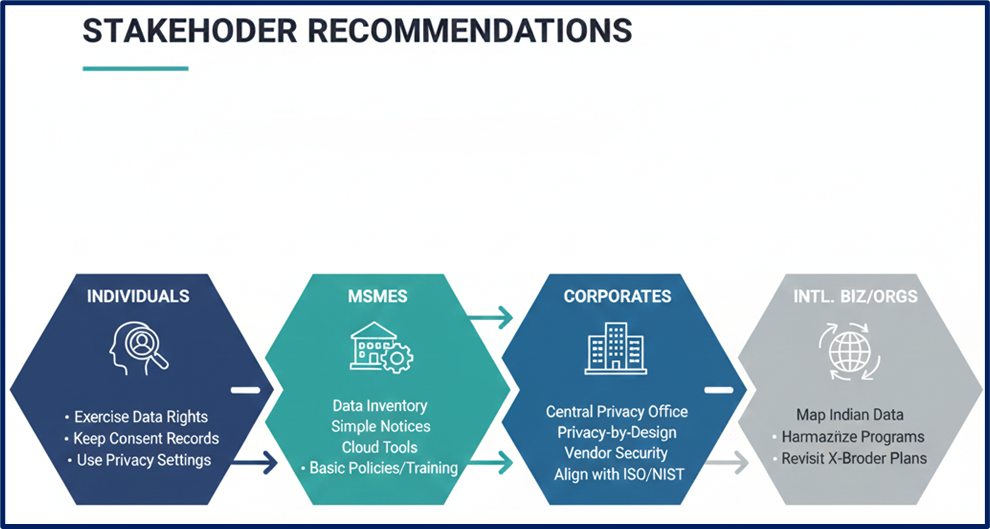
- Make use of your rights to see, fix or delete your data, and keep your own records of the permissions or any complaints you have made.
- Being cautious with over‑sharing, use of privacy settings and verification of Consent Managers and grievance portals before sharing.
Small and Medium Businesses
- Mandatory compliance with limited but material obligations on consent, notices, security and breach notification.
- Classification as SDF is not likely, but sectoral or volume‑driven is possible for fintech, health tech, edtech, and major SaaS providers.
MSMEs
- Start with a pragmatic data inventory: identify what personal data is collected, why, where it is stored and with whom it is shared.
- Standardise simple, plain‑language notices and consent flows aligned with DPDPA requirements.
- Use affordable, cloud‑native tools or managed services for consent, logging, encryption and access control instead of custom‑building.
- Adopt basic policies (privacy policy, retention schedule, breach response SOP) and train key staff handling customer data.
Corporates and Conglomerates
- Establish a central privacy office under a CPO/ DPO, integrated with CISO, Legal, Risk and Compliance functions.
- Build and maintain a dynamic Record of Processing Activities (ROPA)/ data inventory, mapped to purposes, retention and legal bases.
- Implement privacy‑by‑design, using DPIAs for high‑risk initiatives.
- Upgrade third‑party risk management: data protection clauses, SCC‑like contractual safeguards, regular audits and certifications.
- Align DPDPA with existing frameworks (ISO, NIST, RBI/ IRDAI/ TRAI) to avoid cached compliance and leverage shared controls.
Government and Law Enforcement
- Develop detailed SOPs for data access, retention and sharing consistent with DPDPA, with oversight mechanisms and logging to ensure proportionality and accountability.
- Transform LEA and departmental IT infrastructure to withstand DPBI and judicial scrutiny.
- Specialised training for investigators, prosecutors and administrators on lawful handling of digital evidence and personal data under DPDPA.
International Business
DPDPA’s extraterritorial reach applies to entities outside India offering goods/services to individuals in India, requiring them to comply with Indian rules (including consent, notices, rights handling and DPBI enforcement). Cross‑border data transfers will be allowed by default except to a government‑notified negative list of countries or sectors, with additional conditions for critical sectors.
International Organisations
- Map Indian data flows separately and update global privacy notices and contracts accordingly.
- Privacy - a common control baseline with specific overlays.
- Revisit cross‑border transfer and data localisation for high‑risk or highly regulated sectors, for possible negative‑list restrictions.
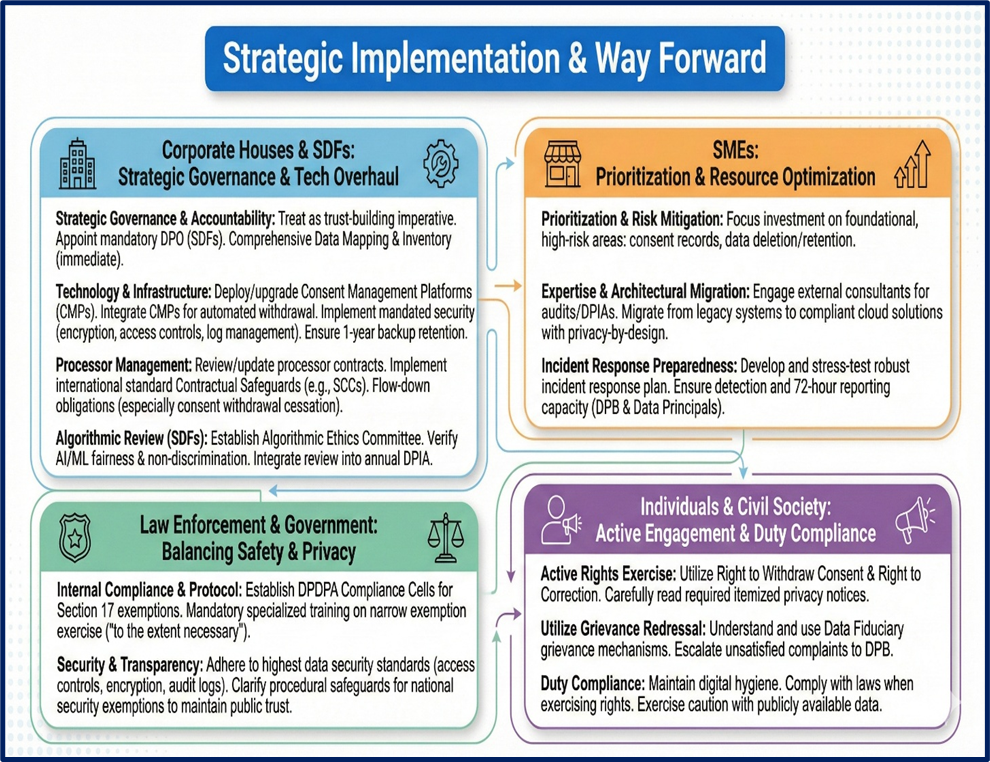
Simplified Implementation: Strategic Recommendations
Across all sectors, successful alignment with the DPDPA 2023 will depend on multiple actions:
- Gap Assessment & Roadmap: Start early by identifying compliance holes and leveraging the 18-24month transition window.
- Invest in Talent: Train "privacy champions" internally and hire specialized experts to bridge the legal-technical gap.
- Governance Integration: Move privacy from a "legal checklist" to a board-level priority with clear KPIs and risk registers.
- Continuous Evolution: Regularly update processes based on new DPBI guidance and changing global standards.
Conclusion:
The enactment of the DPDPA 2023 and the DPDP Rules 2025 indicates the dawn of a new era for India’s digital economy, where privacy is no longer a luxury but a fundamental operational requirement. By carving out a "Third Way" that balances individual rights with economic innovation, DPDPA has provided a realistic blueprint for data governance in the Global South. However, the path compliance is steep, requiring a fundamental shift from reactive legal measures to a proactive "privacy-by-design" culture.
As the 18–24month implementation window unfolds, the success of this landmark legislation will depend on how effectively organizations, from agile startups to sprawling government departments bridge the gap between technical legacy and these new statutory obligations. Ultimately, those who view privacy as a strategic asset rather than a regulatory hurdle will be best positioned to thrive in India’s maturing, trust-based data landscape.